

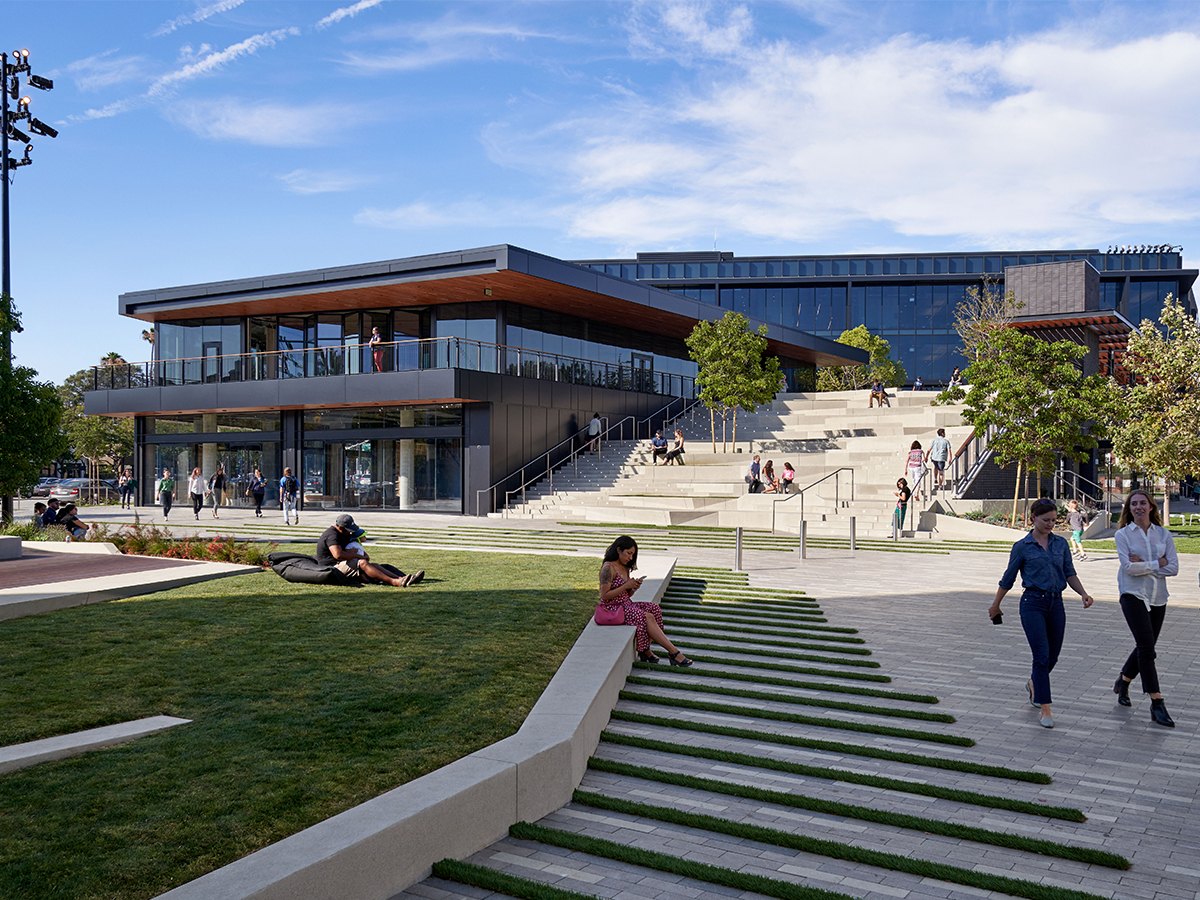
The Culver Steps is a symbol of this city’s evolution into a media and tech hub.
By Brannon Boswel CoStar News
On weekday afternoons, the terraces at The Culver Steps buzz with young professionals grabbing matcha drinks, ducking into high-end grocer Erewhon for a prepared meal or polishing off a scoop of ice cream from Salt & Straw before clustering around laptops in the sun.
The mixed‑use campus that’s home to Amazon workers is now on the market, testing investor appetite for a slice of Culver City about 10 miles west of downtown Los Angeles. The property reflects the area’s evolution from a once‑sleepy studio backlot into one of the strongest tech and media hubs in the nation’s most populous county.
Hackman Capital Partners and Affinius Capital hired Newmark to sell the fully leased campus at 9300 Culver Blvd. that property professionals say could fetch $150 million. The site spanning 122,000 square feet built in 2019 is now both office campus and social hub, pairing offices with high‑end and fast‑casual retail including makeup store Sephora, sushi spot Yunomi Handroll, lunch outpost Mendocino Farms and yoga studio CorePower that draws crowds from morning to evening.
The offering lands at a pivotal moment for Los Angeles real estate, as investors increasingly divide the market between struggling office districts and a handful of elite “flight-to-quality” neighborhoods still attracting technology, media and artificial intelligence tenants. Culver City has emerged as one of the clearest winners of that divide, joining Beverly Hills, Century City and Playa Vista as magnets for companies seeking modern offices, retail amenities and easier west side commutes.
Culver City stands apart because it operates “as a full-scale media ecosystem in this part of town,” according to Gabriel Brown, a JLL broker active in the neighborhood. He points to the city’s concentration of creative tenants including Apple, Sony and TikTok, coupled with popular restaurants and shops.
The sale also gives Hackman Capital an opportunity to monetize one of its strongest-performing investments, while parts of its studio business remain under pressure from Hollywood’s production slowdown.
“It’s the most core mixed-use offering in Los Angeles right now,” said Newmark Vice Chairman Kevin Shannon, who is helping to sell the property. “It’s a trophy product in a bull’s-eye location.”
Still, the listing is not without challenges. While office investment activity is rebounding across the country, sales activity in Culver City remains well below historical norms while the vacancy rate is at a record high of nearly 23%. The offering is likely to appeal to a narrower pool of buyers due to the property’s scale and diverse tenant roster.
A listing of the fully occupied project “is a natural next step for a mature property of this quality,” Mike Racine, Hackman’s executive vice president of asset management, told CoStar News in a statement.
“We’ve established the property as a vibrant, mixed-use retail and office destination and, for the community, a go-to spot for shopping, dining and outdoor gathering,” Racine said.
Culver City’s ascent
What was once largely viewed as a production and back-office district has evolved into one of Los Angeles’ most concentrated clusters for media, technology and creative office tenants. Companies including Apple, Amazon, Pinterest and Nike have all expanded operations in or around Culver City over the past several years.
Landlords say tenant demand has recently accelerated again, particularly among technology and AI firms looking for highly amenitized offices in the west side of Los Angeles. Kilroy Realty Chief Executive Officer Angela Aman told investors during the firm’s latest earnings call that leasing activity in Culver City was being driven by a “wide variety of users including technology and AI companies.”
Despite broader office market softness, average asking rents remain around $52 per square foot, placing Culver City among the 10 most expensive office submarkets in Los Angeles.
The neighborhood has increasingly benefited from the same flight-to-quality dynamic reshaping Los Angeles office leasing. Companies searching for talent-friendly offices have gravitated toward walkable districts with luxury retail, dining and newer buildings while many older office corridors continue to struggle.
JLL’s Brown said the area functions less like a conventional office district and more like a dense creative ecosystem built from former industrial properties converted into striking workplaces for media and technology tenants.
“When you have Apple, Amazon, HBO, Nike and most recently Pinterest planting flags in this location, this kind of brand density really creates an evolution of a market,” Brown said.

Diners at The Culver Steps in Culver City, which is also home to Philz Coffee, below the Laurel Grill. (Kalina Mondzholovska/CoStar)
The Culver Steps sits at the center of that transformation, directly adjacent to Hackman’s 14-acre Culver Studios campus and near Apple’s growing Culver City footprint.
“We are proud of the role The Culver Steps has played in the continued growth of downtown Culver City,” Racine said, adding that Hackman is a “long-term stakeholder” in the area. He pointed to one of the firm’s other holdings — the 26-building Culver Media Portfolio in the Hayden Tract — “where we’ve experienced growing leasing momentum and tenant demand from creative and media tenants.”
Shannon described the downtown corridor as “the Rodeo Drive of Culver City” and said it’s one of the few LA office districts where top-tier tenants are still aggressively competing for space.
“Office is not dead,” Brown echoed. “Capital may be cautious, but occupiers are making intelligent long-term bets.”
Retail growth has followed the office expansion. In recent months, the area has attracted high-profile consumer brands including a new local headquarters for Pop Mart, the retail company behind Labubu, and IKEA’s first Los Angeles store, adding to the neighborhood’s reputation as a hybrid destination for work, entertainment and lifestyle spending.
Hackman’s Culver footprint
The offering also underscores how Hackman Capital Partners has helped shape Culver City’s modern identity. Over the past decade, Michael Hackman’s firm assembled one of the area’s largest portfolios of
creative office and studio properties, helping reposition the district into a center for entertainment and
technology tenants.
The Culver Steps was developed from the ground up by Hackman and Affinius during an earlier wave of optimism around experiential retail and creative office development on LA’s west side.

Culver City has evolved from a sleepy studio backlot into one of LA’s strongest tech and media hubs. (Kalina Mondzholovska/CoStar)
The property’s office component is fully leased to Amazon and functions as part of the company’s broader entertainment footprint surrounding Culver Studios. Amazon MGM Studios also occupies significant space nearby at Culver Studios, creating a larger interconnected campus for the streaming giant’s Los Angeles operations.
That concentration of long-term tenancy has helped insulate The Culver Steps from some of the volatility affecting the broader studio market. While production slowdowns and weaker filming activity have pressured some entertainment-related properties across Los Angeles, The Culver Steps generates stable income backed by long leases and a curated retail lineup.
Hackman Capital has been working through well‑documented challenges at several of its Los Angeles studio properties, including the Radford Studio Center in Studio City, where the firm defaulted on roughly $1.1 billion in debt amid a prolonged production slowdown and has since ceded control of the historic lot to lenders.
The Culver Steps was refinanced in 2024 with a $75 million loan from Deutsche Bank and Wells Fargo. Industry observers say the expected sale price would leave substantial equity for the partnership, reflecting both the appreciation of Culver City real estate and the project’s strong leasing performance.
Shannon said the neighborhood has become significantly more desirable since Hackman built the project nearly a decade ago. The Culver Steps, with a trophy tenant roster, captures the broader evolution of Culver City from production town into one of Los Angeles’ premier tech and media hubs.


